WEC Staff

About WEC Staff

The New Jersey Work Environment Council (WEC) is an alliance of labor, community, and environmental organizations working together for safe, secure jobs, and a healthy, sustainable environment.

Welcome to WEC’s newest intern, Vivian Chang

WEC is excited to have Vivian Chang join us as an intern for this semester, beginning today!       Vivian is a second-year Master in Public Affairs (MPA) candidate at Princeton University’s Woodrow Wilson School, concentrating in environmental policy. Vivian previously served as an AmeriCorps VISTA addressing public education and volunteerism. She holds a Bachelor of Science in Biological Physics and a Bachelor of Arts in Hispanic Studies from Carnegie Mellon University, with a minor in environmental science. She is excited to work with WEC on pressing environmental and labor issues, and key policy topics for New Jersey. In the coming weeks, Vivian will be assisting us with our campaign to Address Climate Change.

By |2017-01-20T12:36:03-05:00January 20th, 2017|Highlights|Comments Off on Welcome to WEC’s newest intern, Vivian Chang

Exposure to Airborne Silica: OSHA penalty for repeat offender in NJ

On Jan. 4, 2017, the U.S. Department of Labor’s Occupational Safety and Health Administration issued citations for one repeat and two failure-to-abate violations. Kris Hoffman, director of OSHA’s Parsippany Area Office stated: “Our follow-up inspection found that two County Concrete employees were exposed to silica above the permissible limit as they cleaned concrete mixers." In 2013, OSHA cited this company for these same hazards, “Employers must bear the responsibility of fully complying with respiratory protection requirements to protect the safety and health of their workers.” OSHA’s Final Silica Rule took effect on June 23, 2016 OSHA estimates that the rule will save over 600 lives and prevent more than 900 new cases of silicosis each year, once its effects are fully realized. The Final Rule is projected to provide net benefits of about $7.7 billion, annually. This rule will help protect approximately 2.3 million workers who are exposed to respirable crystalline silica in their workplaces, including 2 million construction workers who drill, cut, crush, or grind silica-containing materials such as concrete and stone, and 300,000 workers in general industry operations, such as brick manufacturing, foundries, and hydraulic fracturing, also known as fracking. Industries have from one to five years to comply with most [...]

By |2017-01-27T09:49:34-05:00January 19th, 2017|Highlights|Comments Off on Exposure to Airborne Silica: OSHA penalty for repeat offender in NJ

HSN Coalition Meeting March 7

Join the Healthy Schools Now coalition for our quarterly meeting on March 7, 2016 at 10 AM in Trenton, NJ. We look forward to continued discussion about how we can work together to ensure a healthy and safe school environment for all of New Jersey's public schools students. Breakfast and lunch will be provided. Agenda to be posted soon. Register Healthy Schools Now

By |2017-01-20T12:58:05-05:00January 10th, 2017|Highlights|Comments Off on HSN Coalition Meeting March 7

Let’s Build A Movement

Working people can’t seem to get ahead. As we watch the news, engage in our communities, and organize around our respective issues, it becomes more and more apparent that we are operating in a rigged economy, which works for a privileged few. Wall Street’s power and influence continues to thwart progress on our most basic needs, on issues like public health, environmental protection, workers’ rights, and civil rights. The most fundamental component of our democracy, our ability to organize and successfully advocate for our needs, has been undermined. Join us on February 3rd and 4th at the Rutgers Labor Education Center in New Brunswick(50 Labor Center Way) to learn how our economy, and our democracy have been strip-mined by financial institutions. This intensive training will be led by Les Leopold, author of Runaway Inequality and director of The Labor Institute. Join a discussion on direct actions that we can take to address the fundamental inequalities in our system. Space is limited to 20 participants. Apply now for the Public Need over Corporate Greed Trainer Apprenticeship Program and help create an economy that works for everyone.     Learn More Apply Today
By |2017-01-06T02:01:27-05:00January 5th, 2017|Highlights|Comments Off on Let’s Build A Movement

NJTV: Concern Over Public’s Right to Access Emergency Response Plans

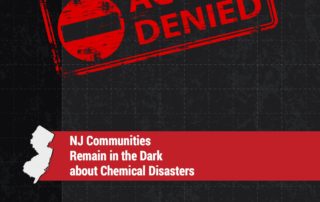
Dan Fatton, WEC executive director, appeared on NJTV News with Mary Alice Williams to discuss WEC's latest report, ACCESS DENIED. For the interview transcript, please click here. Several clarifications: As noted in the report, an estimated 12 million people live or work within the danger zones of NJ facilities; however, not all those people are NJ residents. EPCRA is the Emergency Planning and Community Right-to-Know Act, a 1986 federal law created to help communities plan for chemical emergencies. SERC is the State Emergency Response Commission. ACCESS DENIED REPORT

By |2016-12-28T21:56:05-05:00December 28th, 2016|Highlights, WEC in the News|Comments Off on NJTV: Concern Over Public’s Right to Access Emergency Response Plans

ACCESS DENIED: New Research Report Details Governor Christie’s Violation of Federal Law Requiring Public Access to Local Emergency Response Plans

Governor Chris Christie continues to fail in carrying out his legal responsibility under federal law for ensuring that the public has access to an up-to-date Emergency Response Plan (ERP) in each of New Jersey’s counties and municipalities in the event of a chemical plant fire, explosion, or other toxic emergency. The Governor's State Emergency Response Commission (SERC) is supposed to ensure public access to these plans. However, despite acknowledgment of the violation, they have not done so. Public access to these Emergency Response Plans as required under the 1986 Emergency Planning and Community Right to Know Act (EPCRA) is critical given that New Jersey has more than 5,000 facilities that use large amounts of hazardous chemicals, with the highest population density of any state. As detailed in a new research report issued today, ACCESS DENIED, the New Jersey Work Environment Council (WEC) wrote to the 59 municipalities and 19 counties that host the 95 most potentially hazardous facilities that are regulated by the NJ Toxic Catastrophe Prevention Act (TCPA), requesting to review the community Emergency Response Plans as authorized by EPCRA. Thirty-four municipalities (or 58%) and 16 counties (also 84%) denied the request, reflecting continued confusion about the federal [...]

By |2016-12-21T10:34:16-05:00December 21st, 2016|Highlights, Press Releases|Comments Off on ACCESS DENIED: New Research Report Details Governor Christie’s Violation of Federal Law Requiring Public Access to Local Emergency Response Plans

Access Denied: NJ Communities Remain in the Dark About Chemical Disasters

Access Denied documents how Governor Chris Christie continues to fail in carrying out his legal responsibility under federal law for ensuring that the public has access to an up-to-date Emergency Response Plan (ERP) in each of New Jersey’s counties and municipalities in the event of a chemical plant fire, explosion, or other toxic emergency. The Governor's State Emergency Response Commission (SERC) is supposed to ensure public access to these plans. However, despite acknowledgment of the violation, they have not done so. Read Full Report Press Release Respect Our Right to Know

By |2017-03-30T16:46:19-04:00December 20th, 2016|WEC Reports|Comments Off on Access Denied: NJ Communities Remain in the Dark About Chemical Disasters

No minimum wage hike for workers, but Christie gets a book deal?

"In exchange for small-but-overdue salary increases for legislative and judicial staff,  Christie is demanding a king's ransom for himself and his inner circle. Under the terms of a plan he's pushing legislators to accept,  members of his cabinet would be in line for $34,000 annual raises. Those political appointees could see their salaries skyrocket to $175,000,  a 24 percent increase from their current maximum of $141,000 per year. It's time for some perspective because this is the same governor who has repeatedly and viciously attacked public employees over their salaries and benefits. This is the same governor who opposes gradually raising the minimum wage to $15 per hour to help average New Jersey residents and working families improve their lives. Somehow,  he thinks that $15 per hour is too much for a single working mother struggling to feed and shelter her family. At the current minimum wage of $8.38 per hour,  she'd make just over $17,000 per year if she never took a single day off. To Christie,  that's enough for her. But for his cabinet that already makes eight times that much? He thinks they need raises of $34,000 per year. This is a governor whose hypocrisy on salaries [...]

By |2016-12-19T11:36:24-05:00December 19th, 2016|Highlights, Opinion Pieces|Comments Off on No minimum wage hike for workers, but Christie gets a book deal?

Strengthening Protections for Workers Against Wage Theft

Since 1986, the Work Environment Council of New Jersey has fought for safe, secure jobs and a healthy sustainable environment. We’ve spent years working to link workers, communities, and environmental activists through training, grassroots organizing, and policy campaigns. First and foremost, WEC is concerned with public health and the well-being of workers. But it’s important that while we maintain a broad vision in defining public health, that we address the economic policy that keeps working people and communities in danger. That’s one reason why WEC supports A862, a bill which strengthens protections for workers against wage theft. The bill, which passed out of the Assembly Labor Committee on December 12, would deter employers from committing wage theft by strengthening penalties, increasing the amount of time a worker has to file a claim, protecting workers who file claims from retaliation, and by holding employers who use subcontractors accountable. How is wage theft connected to public health, though? Aren’t wages and labor economic practices a separate issue from public health? In fact, an economy that is dependent on wage theft and low wages is extremely damaging to public wellbeing. When a family worries about how they will pay for groceries, their health is [...]

By |2016-12-15T18:38:35-05:00December 14th, 2016|Highlights|Comments Off on Strengthening Protections for Workers Against Wage Theft

What Is An Ideal Wage Gap?

According to public opinion polls, Americans typically believe a good pay ratio is 7 to 1. In other words, the top paid CEO in the United States should make 7 times what the average worker makes. And yet the American reality is much different. In fact, the top paid CEOs in the United States make roughly 844 times what the average worker makes. This stunning statistic represents the antithesis of the American dream: the idea that if someone works hard then they deserve financial security; it also belies the myth that as the pool of wealth increases, all boats rise. These outrageously disparate numbers indicate a broken economy, engineered by the top 1/10th of the 1% wealthiest Americans, which has fostered a destructive and amoral distribution of wealth. In a move to address the extreme and corrupt distribution of wealth, the city council of Portland, Oregon passed a tax this Wednesday on companies in which the top-ranked executives make more than 100 times the median pay of their average workers. In doing so, the city of Portland has shown it is willing to take steps to reverse the negative effects that extreme income inequality has on its residents. [...]

By |2016-12-14T00:23:26-05:00December 13th, 2016|Highlights|Comments Off on What Is An Ideal Wage Gap?
Go to Top